
Evidence based supplement recommendations: how funding models shape what you’re told to buy

That article recommending a specific brand of magnesium for sleep? There’s a decent chance the author earns 10-20% commission on every sale made through their links. The article that ranked “the 12 best vitamin D supplements” last month? Probably assembled by working backward from which brands offer affiliate programs, then writing justifications for each one.
This isn’t a conspiracy theory. It’s a business model, and it’s how the majority of supplement content on the internet gets funded. The question isn’t whether affiliate marketing exists (it obviously does) and every major supplement review site participates in it. The question is whether you understand how it shapes the recommendations you’re reading, and whether you know what evidence based supplement recommendations actually look like when they’re not filtered through a sales incentive.
A necessary disclaimer: This article discusses financial incentive structures in health content. We’re not offering legal or financial advice. If you’re making health decisions based on supplement recommendations from any source, including this one, verify claims against peer-reviewed research and consult qualified professionals for medical concerns.
How supplement affiliate marketing works
The basic mechanics are simple. A website publishes an article recommending supplements. The article contains links to purchase those supplements, usually through Amazon Associates, ShareASale, or individual brand affiliate programs. When a reader clicks a link and buys the product, the website earns a commission, typically between 8% and 20% of the sale price.1Federal Trade Commission. “FTC’s Endorsement Guides: What People Are Asking.” FTC Business Guidance, updated July 2025. https://www.ftc.gov/business-guidance/resources/ftcs-endorsement-guides-what-people-are-asking
The FTC requires disclosure of these relationships and mandates that disclosures be “clear and conspicuous” placed near the relevant content, not buried in a footer or About page.216 CFR Part 255 — Guides Concerning Use of Endorsements and Testimonials in Advertising. Electronic Code of Federal Regulations. https://www.ecfr.gov/current/title-16/chapter-I/subchapter-B/part-255 In practice, compliance varies wildly. Some sites put a clear statement at the top of every review article. Many others use a vague line like “we may earn commissions from links on this page” in small text that you’d have to scroll past the content to find. The FTC’s own guidance notes that labeling something as an “affiliate link” alone is inadequate because most consumers don’t know what that term means.
The commission structure itself creates a specific set of incentive distortions. A site recommending a $60 magnesium complex earns more per sale than one recommending an $8 bottle of magnesium glycinate, even when the active ingredient, dose, and evidence base are identical. A site that recommends eight supplements for sleep earns more than one that honestly tells you magnesium and good sleep hygiene might be all you need. A site reviewing only brands that participate in its affiliate network will never recommend the perfectly good store-brand option that doesn’t have an affiliate program.
None of this means every affiliate recommendation is bad. Plenty of sites use affiliate revenue to fund genuinely useful content, and some maintain editorial standards that resist the financial pressure to recommend expensive products over cheap ones. But the incentive structure is real, it pulls in a specific direction, and pretending it doesn’t affect content is naive.
Recognizing incentive-driven recommendations
Once you know what to look for, the patterns are obvious.
The most reliable tell is product-focused language versus ingredient-focused language. An evidence based source explains that magnesium glycinate at 200-400mg supports sleep quality through GABA receptor activation, then mentions that this ingredient is widely available from many manufacturers including generic options. An affiliate-driven source tells you “Brand X Magnesium Sleep Complex is our #1 pick” and spends two paragraphs on the packaging and flavor options before mentioning the active ingredient in passing.
Ranked product lists where every item links to the same retailer are another strong signal. If a “best supplements” article features ten products and all ten link to Amazon, the selection criteria likely started with “what’s available on Amazon with an affiliate program” rather than “what does the evidence support.” This is especially telling when you notice the absence of well-regarded products that happen to be sold primarily through the manufacturer’s own website, where the review site has no affiliate relationship.
Watch for price insensitivity. Evidence based recommendations acknowledge that many branded supplements contain the same ingredients at the same doses as cheaper alternatives, and that third-party testing certifications are a better indicator of quality than brand name or price point. Affiliate-driven content rarely mentions this, because acknowledging that a $12 product works as well as a $45 one cuts revenue by two-thirds.
The “more is better” pattern is worth noticing too. Sites that earn per-product commissions have a structural incentive to recommend long supplement stacks. A 15-supplement morning routine generates more clicks than honest advice about which two or three supplements actually have strong evidence for your specific situation. If an article recommends a dozen products for a single health goal without addressing why all of them are necessary, the recommendation list may be optimized for revenue, not for your health.
What this costs you
The financial cost is the most concrete. A reader following affiliate-driven “best of” recommendations might spend $45-60 per month on branded versions of supplements available as generics for $15-20. Over a year, that’s potentially $300-500 in unnecessary spending on markup that buys you a fancier label, not a better product.
But the information cost matters more. When supplement recommendations are shaped by what pays well rather than what the evidence supports, readers develop distorted mental models about supplementation. They come to believe that brand selection is the most important decision (it usually isn’t, ingredient and dose matter far more than the label on the bottle). They accumulate supplements they don’t need because no one in the recommendation chain has an incentive to say “you probably don’t need this.” And they miss the practical knowledge about bioavailability, timing, and interactions that determines whether the supplements they do take actually work.
The food-first problem is related. You can’t earn an affiliate commission on “eat more leafy greens for magnesium” or “get 15 minutes of midday sun for vitamin D.” Dietary advice that reduces supplement purchases is financially counterproductive for affiliate-funded sites, which creates a systematic bias toward supplementation over dietary solutions even when the dietary solution is better supported by evidence.
Every source has a funding model
This is the part that most “affiliate marketing bad” articles get wrong, and it’s worth getting right.
Every website and content creator that provides supplement information needs revenue to operate. The question isn’t whether a source makes money, it’s how their revenue model aligns or conflicts with giving you accurate information. Affiliate marketing is one funding model among many, and they all create incentive structures worth understanding.
Government-funded sources like the NIH Office of Dietary Supplements and PubMed-indexed research are funded by taxpayer dollars and grants. Their incentive structure favors institutional credibility and scientific rigor, though they can be slow to update and overly cautious in their conclusions. They’re also occasionally shaped by the funding priorities of granting agencies. Excellent for raw evidence, less useful for practical application.
Subscription-funded sites (Examine.com being the best-known example in the supplement space) charge readers directly for access. This aligns their incentive with providing information valuable enough that readers keep paying. The model works well for editorial independence but creates a barrier to access and still doesn’t eliminate all bias, subscriber expectations can shape content priorities.
Brand-owned content comes from supplement manufacturers who publish educational articles and research summaries on their own sites. Some of it is genuinely excellent, produced by qualified scientists. All of it exists to sell the brand’s products. The conflict is obvious and permanent, which paradoxically makes it easier to account for than subtler biases.
Affiliate-funded sites make money when you buy products through their links. As discussed above, this creates specific and predictable distortions: toward expensive products, toward more products, toward brands with affiliate programs, away from generics and dietary solutions.
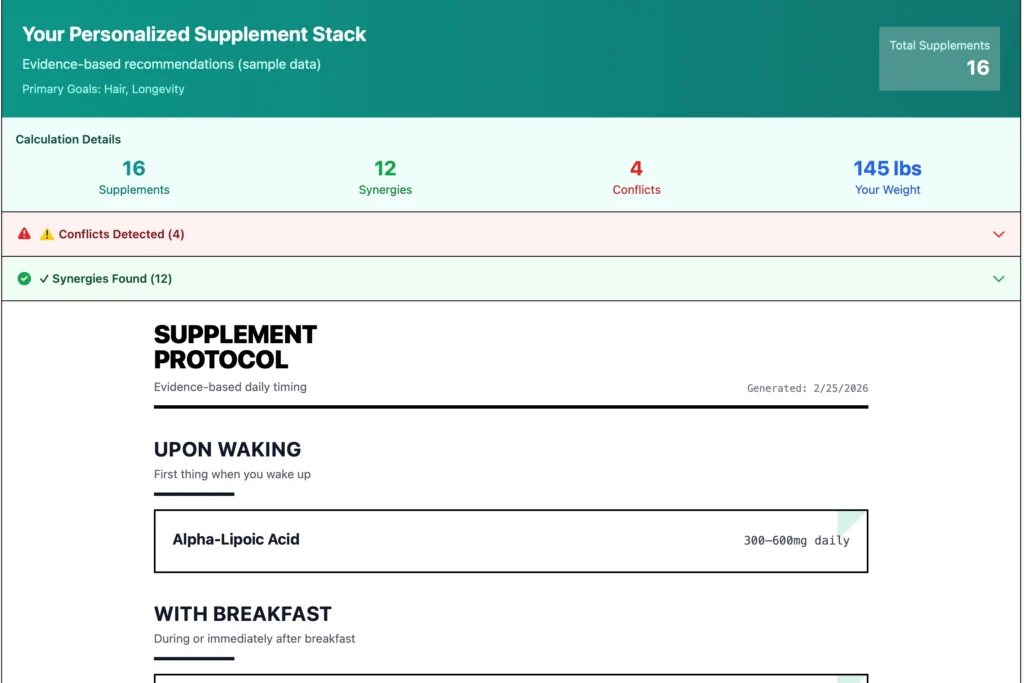
Tool-funded sites (this is where SighedEffects fits) charge for analysis and tools rather than earning from product sales. Our Smart Stack Builder costs $9.99-$19.99. We don’t carry affiliate links. The incentive structure means we benefit when you find the tools useful, not when you buy a specific product. This doesn’t make us infallible or free of all bias, we have an incentive to make supplementation seem complex enough to warrant using a tool, for instance, but it does mean our recommendations aren’t shaped by which brands pay us.
No funding model is perfectly neutral. The useful skill isn’t finding a source with zero conflicts, that source doesn’t exist. It’s understanding what each source’s conflicts are and adjusting your trust accordingly.
What evidence based recommendations look like
Evidence based supplement recommendations share characteristics regardless of who produces them, and these characteristics are easy to check against any source you’re reading.
They focus on ingredients and dosages rather than brands. The primary recommendation is “magnesium glycinate at 200-400mg” rather than “Brand X Magnesium.” Brand-specific recommendations, when they appear, are justified by concrete factors like NSF or USP certification, use of a specific bioavailable form, or independent lab testing results, not by vague quality claims.
They cite specific research. When a source says a supplement works for a specific purpose, evidence based content points you to the actual studies, ideally accessible through PubMed or NIH databases, rather than vague appeals to “research” or “science.” The citations should be checkable. If a claim is supported by a single small study, an honest source says so rather than presenting it as settled science.
They acknowledge when supplements aren’t necessary. An evidence based source will tell you that most people eating a varied diet don’t need a multivitamin, that vitamin C supplementation does little for people who already get adequate dietary intake, and that the evidence for many popular supplements ranges from weak to nonexistent. Sources that never tell you to take less are telling you something about their incentives.
They address the practical factors that determine whether supplements work. Bioavailability (whether you actually absorb what you swallow), timing (when to take what relative to meals, sleep, and other supplements), and interactions (which combinations reduce absorption or create safety concerns) are where the real optimization happens. These factors don’t generate affiliate revenue, which is why most product-focused sites barely mention them.
How to evaluate any supplement source in 60 seconds
This isn’t complicated. Before taking any supplement recommendation seriously, check four things.
First, search the page for “affiliate,” “commission,” or “earn.” If the page has affiliate links, the disclosure should be near the top. If you can’t find it, the site is either non-affiliate or non-compliant with FTC guidelines. Either way, you’ve learned something useful.
Second, check whether the recommendations are ingredient-focused or product-focused. Is the article explaining why you need 200mg of magnesium glycinate, or is it telling you to buy Brand X? Ingredient-first content is a strong signal of evidence based thinking. Product-first content is a signal of sales-oriented thinking.
Third, look for specific citations. Does the article reference identifiable studies, or does it rely on phrases like “research shows” and “experts recommend” without naming the research or the experts? Verifiable claims are the minimum standard for evidence based content. You can check any cited study against PubMed (pubmed.ncbi.nlm.nih.gov) in seconds.
Fourth, check whether the source ever recommends against supplementation. If every article concludes that you should buy something, the content is optimized for sales, not for accuracy. Evidence based sources regularly conclude that specific supplements aren’t worth taking, that dietary changes are preferable, or that the evidence doesn’t support a popular claim.
Frequently asked questions
How do I find unbiased supplement recommendations?
Completely unbiased recommendations don’t exist, every source has a funding model and perspective that creates some form of bias. What you can find are sources whose biases are transparent and whose incentive structures don’t directly conflict with accurate recommendations. Look for ingredient-focused (not brand-focused) content with specific citations to peer-reviewed research. Also pay attention to whether the source ever recommends against supplementation, that willingness is a strong credibility signal. Government databases like the NIH Office of Dietary Supplements provide raw evidence. Tool-based services like SighedEffects provide applied analysis without affiliate revenue.
Are expensive supplement brands better than generic?
Sometimes, for specific reasons. A brand with NSF or USP certification has paid for independent verification that what’s on the label is what’s in the bottle, and that’s worth a modest premium. A brand using a patented bioavailable form of an ingredient (like methylfolate versus folic acid) may justify a higher price based on the form, not the brand. But for most standard supplements (magnesium glycinate, vitamin C, zinc, basic fish oil), the generic store-brand version contains the same active ingredient at the same dose, often manufactured in the same facility as the branded version. The $60 “sleep complex” and the $10 magnesium glycinate are frequently the same molecule with different marketing.
How can I tell if supplement advice is biased?
Follow the money. Check for affiliate disclosures near the top of the content (not buried in a footer). Count how many specific products are recommended versus how much ingredient-level explanation is provided. Notice whether the source ever tells you not to buy something. Check whether generic alternatives are mentioned alongside branded products. And verify specific claims against PubMed, if a site says a supplement “has been shown to” do something, the underlying study should be findable and should actually say what the site claims it says.
What’s wrong with affiliate marketing for supplements?
The practice itself is legal and widely used. The problem is the specific incentive distortion: sites earn more when you buy more expensive products, buy more products total, and buy through their links rather than finding cheaper alternatives elsewhere. These incentives don’t prevent good recommendations, but they create consistent pressure toward recommendations that are optimized for revenue rather than for your health or wallet. The issue isn’t that affiliate sites are dishonest, many are well-intentioned, it’s that the financial structure systematically rewards certain kinds of recommendations over others, and most readers aren’t aware of this when evaluating the advice they receive.
Generate Your Stack. Avoid Conflicts. Optimize Absorption.
Most supplement advice ignores timing, interactions, and dose-response curves. Smart Stack Builder doesn't. Get a personalized daily schedule with interaction flags and dosage guidance, built on the same evidence base as this article.
References
- 1
- 2
This article is part of our Supplements hub: A science-backed collection of ingredient research, clinical dosage reviews, and optimized stack insights.